


Codependency: Meaning, Examples & Symptoms
Summary: Codependency
Codependency is a behavioral pattern in which a person prioritizes another person’s needs, emotions, and problems over their own — often at the expense of their mental health, boundaries, and sense of self. It commonly develops in relationships with someone struggling with addiction, mental illness, or other destructive behaviors, and is characterized by low self-esteem, people-pleasing, poor boundaries, and fear of abandonment. While codependency is not a formal clinical diagnosis, it is widely recognized by mental health professionals and is highly treatable through therapy. At Overland IOP in Los Angeles, our outpatient treatment programs address codependency alongside co-occurring conditions like anxiety, depression, and substance use disorders through individual therapy, group therapy, and evidence-based approaches including CBT and DBT.
Do you find yourself making many sacrifices for your partner’s happiness but not getting much in return? If that kind of one-sided pattern sounds like yours, you don’t have to feel trapped. For many of us, codependency isn’t easy to understand; we may keep asking, “Why doesn’t she just leave him?” and find it difficult to accept the answers we get. Codependents usually don’t share their partners’ addiction, but their lives tend to be taken over with the burden of caring for and protecting the spouse or partner. Recently, people have started claiming that all kinds of conditions—anorexia, overeating, gambling, fear of intimacy, etc.—can result in codependency. Many experts think all of this has gone too far; still, almost everyone agrees that significant others of alcoholics and drug addicts face unique difficulties and should look for support and advice at facilities like Overland IOP. If you need FREE help, please contact the National Helpline about mental and substance use disorders, prevention, treatment, and recovery in English and Spanish.
Codependency: Meaning
Codependency is a psychological condition or a relationship in which a person manifesting low self-esteem and a strong desire for approval has an unhealthy attachment to another, often controlling or manipulative person (such as someone with an addiction to drugs or alcohol). Codependency affects one’s ability to maintain healthy relationships. While it’s not always recognized as a diagnosable illness, codependency is extremely common and is often referred to as “relationship addiction.” Someone with a codependent personality typically has a negative relationship with themselves. Therefore, they feel compelled to receive self-worth from external sources like other people. Dependency has been known for centuries, but the concept of codependency got its name only as recently as 1979. “Codependent” originally was a term that applied to the spouse of an alcoholic. While it still is commonly used to describe a person’s relationship with someone who is dependent on alcohol or drugs, it also applies more broadly to any relationship in which someone—a spouse, partner, friend, sibling, parent, or coworker, for example—focuses on taking care of another person’s needs at the expense of their own.
Codependency: Examples
Codependency can happen in any type of relationship, romantic or not. Below are some examples of codependent situations and relationships.
Codependency Example 1:
A woman is married to a man who is an alcoholic. She always puts his needs before her own and thinks she can help him become sober by showing him affection. She is unknowingly enabling him by giving him everything he requests and covering up for his destructive behavior. She blames a lot of the relationship’s issues on herself and will do anything it takes, including sacrificing her own mental well-being, to make it work.
Codependency Example 2:
A new community college graduate has the opportunity to pursue her dream job in a different part of the country. Because of her mother’s mental health issues, she chose to stay home for college and take care of her. She would like to put her career and her needs first but chooses to take a smaller local job instead so that she won’t have to risk disappointing her mother or telling her that she is leaving. She thinks her mother needs her, so she puts her needs aside.
Codependency Example 3:
In another scenario, a private college graduate moves back home. He is not trying to get a job in his field or pursue any career. Instead, he stays in his parents’ house most of the day and plays video games. He says he will try to find a new place to live soon but says that he doesn’t have any money. Therefore, the parents will continue to support the new graduate financially as he still doesn’t make any effort to move forward with his life.
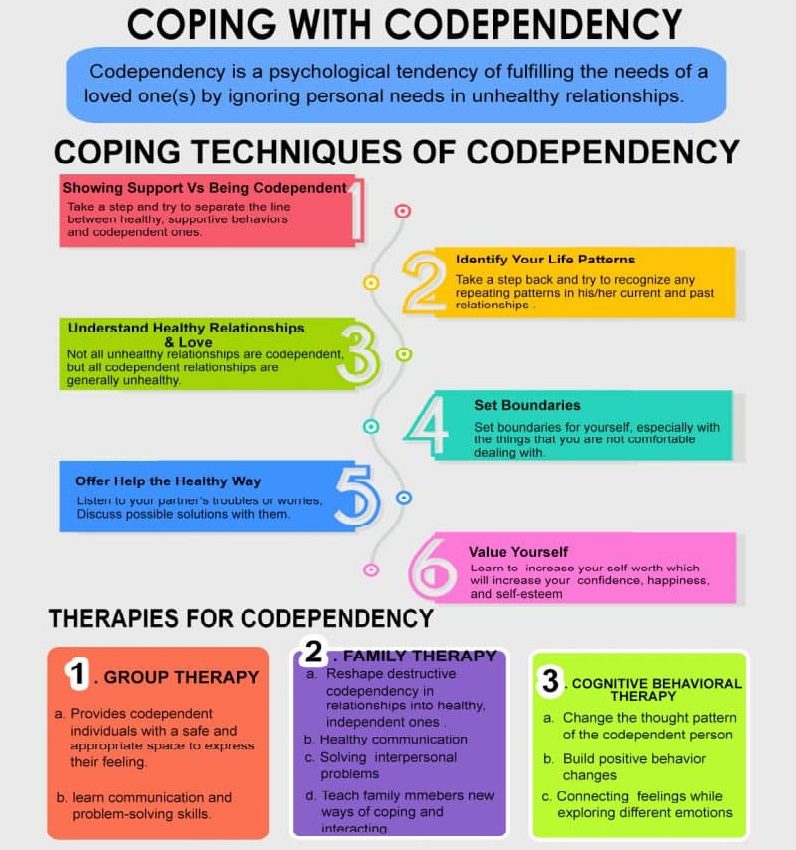
Symptoms Of Codependency
Following is a list of symptoms of codependency. Researchers also found that codependent symptoms got worse if left untreated. The good news is that they’re reversible. You needn’t have all of them to qualify as codependent.
- Low self-esteem. Feeling that you’re not good enough or comparing yourself to others are signs of low self-esteem. The tricky thing about self-esteem is that some people think highly of themselves, but it’s only a disguise — they actually feel unlovable or inadequate. Underneath, usually hidden from consciousness, are feelings of shame. Guilt and perfectionism often go along with low self-esteem. If everything is perfect, you don’t feel bad about yourself.
- People-pleasing. It’s fine to want to please someone you care about, but codependents usually don’t think they have a choice. Saying “no” causes them anxiety. Some codependents have a hard time saying “no” to anyone. They go out of their way and sacrifice their needs to accommodate other people.
- Poor boundaries. Boundaries are an imaginary line between you and others. It divides up what’s yours and somebody else’s, and that applies not only to your body, money, and belongings but also to your feelings, thoughts, and needs. That’s especially where codependents get into trouble. They have blurry or weak boundaries. They feel responsible for other people’s feelings and problems or blame their own on someone else. Some codependents have rigid boundaries. Others find it challenging to connect with them due to their closed-off and withdrawn nature. Sometimes, people flip back and forth between having weak boundaries and having rigid ones.
- Reactivity. A consequence of poor boundaries is that you react to everyone’s thoughts and feelings. If someone says something you disagree with, you either believe it or become defensive. You absorb their words because there’s no boundary. If you had a boundary, you would understand that it is merely their opinion and not a reflection of yourself, which would help you avoid feeling threatened by disagreements.
- Caretaking. Another effect of poor boundaries is that when someone else has a problem, you may feel compelled to help them to the extent that you sacrifice your own well-being. It’s natural to feel empathy and sympathy for someone, but codependents start putting other people ahead of themselves. In fact, they need help and might feel rejected if another person doesn’t want it. Moreover, they keep trying to help and fix the other person, even when that person clearly isn’t taking their advice.
- Control. Control helps codependents feel safe and secure. Everyone needs some control over events in their life. You wouldn’t want to live in constant uncertainty and chaos, but for codependents, control limits their ability to take risks and share their feelings. Occasionally they have an addiction that either helps them loosen up, like alcoholism, or helps them hold their feelings down, like workaholism, so that they don’t feel out of control. Codependents also need to control those close to them because they need other people to behave in a certain way to feel okay. In fact, codependents can use people-pleasing and caretaking to control and manipulate others. In fact, codependents can use people-pleasing and caretaking to control and manipulate others.his is a violation of someone else’s boundary.
- Dysfunctional communication. Codependents have trouble when it comes to communicating their thoughts, feelings, and needs. Of course, if you don’t know what you think, feel, or need, this becomes a problem. At other times, you are aware of your feelings or needs, but you hesitate to acknowledge them. At other times, you are aware of your feelings or needs, but you hesitate to acknowledge them.et someone else. Instead of saying, “I don’t like thatyou would rather not upsetat it’s okay or tell someone what to do. Communication becomes dishonest and confusing when you try to manipulate the other person out of fear.
- Obsessions. Codependents have a tendency to spend their time thinking about other people or relationships. Such behavior is caused by their dependency and anxieties and fears. They can also become obsessed when they think they’ve made or might make a “mistake.” Sometimes you can lapse into fantasy about how you’d like things to be or about someone you love as a way to avoid the pain of the present. This is one way to stay in denial, discussed below, but it keeps you from living your life.
- Dependency. Codependents require the approval of others to feel good about themselves. They’re afraid of being rejected or abandoned, even if they can function on their own. Others always need to be in a relationship because they feel depressed or lonely when they’re by themselves for too long. This trait makes it hard for them to end a relationship, even when the relationship is painful or abusive. They end up feeling trapped.
- Denial. One of the problems people face in getting help for codependency is that they’re in denial about it, meaning that they don’t face their problem. Usually, they think the problem is someone else or the situation. They either keep complaining, try to fix the other person, or move from one relationship or job to another without acknowledging that they have a problem. Codependents also deny their feelings and needs. Often, they don’t know what they’re feeling and are instead focused on what others are feeling. The same thing goes for their needs. They pay attention to other people’s needs and not their own. They might be in denial of their need for space and autonomy. Although some codependents seem needy, others act like they’re self-sufficient when it comes to needing help. They won’t reach out and have trouble receiving. They are in denial of their vulnerability and need for love and intimacy.
- Intimacy issues are prevalent. By this, I’m not referring to sex, although sexual dysfunction often is a reflection of an intimacy problem. I’m talking about being open and close with someone in an intimate relationship. You might fear judgment, rejection, or leaving due to shame and weak boundaries. Conversely, you might worry about a relationship suffocating you and taking away your independence. Conversely, you might worry about a relationship suffocating you and taking away your independence.me; your partner complains that you’re unavailable, but he or she is denying his or her need for separateness.
- Painful emotions. Codependency creates stress and leads to painful emotions. Shame and low self-esteem create anxiety and fear about being judged, rejected, or abandoned; making mistakes; being a failure; and feeling trapped by being close or being alone. The other symptoms lead to feelings of anger and resentment, depression, hopelessness, and despair. When the feelings are too much, you can feel numb.
How to Know You’re in a Codependent Relationship?
How can you determine if you are in a codependent relationship?codependent relationship:
- Are you unable to find satisfaction in your life outside of a specific person?
- Do you recognize unhealthy behaviors in your partner but stay with them in spite of them?
- Are you giving support to your partner at the cost of your own mental, emotional, and physical health?

Individuals can also assume they are in a codependent relationship if people around them have given them feedback that they are too dependent on their partner or if they have a desire, at times, for more independence but feel an even stronger conflict when they attempt to separate in any way. They’ll feel anxiety more consistently than any other emotion in the relationship. And they’ll spend a great deal of time and energy either trying to change their partner or … trying to conform to their partner’s wishes.
FAQs About Codependency
Q1: What is codependency?
Codependency is a relational pattern in which one person becomes excessively focused on meeting another person’s needs — emotionally, physically, or financially — while neglecting their own well-being. It often develops in relationships involving addiction, mental illness, or chronic dysfunction. The codependent person may enable harmful behaviors, struggle to set boundaries, and derive their self-worth from being needed. Although the term originated in the 1970s to describe partners of people with alcohol addiction, it now applies broadly to any relationship where one person’s identity and emotional stability become dependent on caring for or controlling another. APA — Codependency Definition
Q2: What are the signs of a codependent relationship?
Common signs of a codependent relationship include difficulty saying no or setting boundaries, putting your partner’s needs consistently above your own, feeling responsible for your partner’s emotions or problems, staying in unhealthy or abusive relationships out of fear of being alone, low self-esteem that depends on your partner’s approval, and enabling destructive behavior such as substance use. You may also experience chronic anxiety about the relationship, difficulty making decisions independently, and a pattern of sacrificing your own goals, friendships, or health to keep the relationship intact. If several of these patterns feel familiar, it may be worth exploring treatment options.
Q3: Is codependency a mental health disorder?
Codependency is not currently listed as a formal diagnosis in the DSM-5 (Diagnostic and Statistical Manual of Mental Disorders). However, it is widely recognized by mental health professionals as a significant behavioral pattern that contributes to anxiety, depression, low self-esteem, and relationship dysfunction. Some researchers have proposed it as a personality disorder, and it frequently co-occurs with diagnosable conditions including generalized anxiety disorder, depressive disorders, and substance use disorders. Regardless of its diagnostic classification, codependency responds well to structured therapeutic treatment including individual therapy, group therapy, and evidence-based modalities like CBT. NIMH — Mental Illness
Q4: What causes codependency?
Codependency typically develops from early childhood experiences in dysfunctional family environments — particularly families affected by addiction, emotional neglect, abuse, or chronic illness. Children who grow up learning to suppress their own needs in order to manage a parent’s emotions or behavior are more likely to carry those patterns into adult relationships. Other contributing factors include growing up with overly controlling or emotionally unavailable caregivers, being parentified (taking on adult responsibilities as a child), and cultural or family norms that reinforce self-sacrifice over healthy boundaries. Codependency is a learned behavior pattern, which means it can be unlearned through therapy and intentional practice.
Q5: How is codependency treated?
Codependency is most effectively treated through a combination of individual therapy, group therapy, and psychoeducation. Cognitive Behavioral Therapy (CBT) helps identify and change the thought patterns that drive people-pleasing and poor boundary-setting. Dialectical Behavior Therapy (DBT) builds skills in emotional regulation, distress tolerance, and interpersonal effectiveness — all areas where codependent individuals typically struggle. Group therapy provides peer support and the opportunity to practice healthy relational patterns in a safe setting. At Overland IOP in Los Angeles, codependency treatment is integrated into our outpatient programs alongside treatment for co-occurring conditions like anxiety, depression, and substance use disorders. NIMH — Psychotherapies
Q6: Can codependency lead to anxiety or depression?
Yes. Codependency frequently contributes to or worsens anxiety and depression. The chronic pattern of suppressing your own needs, walking on eggshells around a partner, and deriving self-worth from someone else’s approval creates persistent emotional stress. Over time, this can manifest as generalized anxiety disorder, social anxiety, major depressive disorder, feelings of hopelessness, and emotional exhaustion. Many individuals seeking treatment for anxiety or depression discover that underlying codependency patterns are a significant contributing factor. Addressing codependency in outpatient treatment can significantly improve both mental health symptoms and relationship functioning.
Q7: Does Overland IOP treat codependency in Los Angeles?
Yes. Overland IOP in Los Angeles treats codependency as part of our Intensive Outpatient Program (IOP) and Partial Hospitalization Program (PHP) for adults. Our clinical team addresses codependency alongside co-occurring mental health conditions such as anxiety, depression, PTSD, and substance use disorders using evidence-based therapies including CBT, DBT, Acceptance and Commitment Therapy, and psychodynamic therapy. Treatment includes individual therapy, group therapy, and family support — all within a flexible outpatient schedule with morning, afternoon, and evening tracks, plus in-person and virtual options. We are currently accepting new patients and accept most major insurance plans. Call (800) 530-3100 to schedule a free consultation.


Codependency can be treated alone or with medical supervision, but it’s best to have a support system when addressing the issue. To rid oneself of codependent thoughts and behaviors, you must first be educated about the topic. There are plenty of magazines, articles, and other reading materials about the topic that can help you understand your own tendencies. Other habit changes that can help influence positive change include staying sober (and encouraging your partner to), engaging in talk therapy (group, family, or individual), and putting oneself in a new environment that doesn’t require caretaking for someone else. To learn more about codependent personalities or to get more options regarding treatment for this condition, contact our team of mental health professionals & read more about codependency.
If you need FREE help, please contact the National Helpline about mental and/or substance use disorders, prevention, treatment, and recovery in English and Spanish.
Published: January 02, 2022
Last Updated: February 12, 2026




Published: February 14, 2026
Medication-Assisted Treatment (MAT): How It Works?
Summary: Medication-assisted treatment (MAT) is an evidence-based approach to addiction treatment that combines FDA-approved medications with behavioral therapy and counseling to treat substance use disorders — primarily opioid and alcohol addiction. MAT is endorsed by the Substance Abuse and Mental Health Services Administration (SAMHSA), the National Institute on Drug Abuse (NIDA), and the World Health […]
Read more
Published: February 06, 2026
Talk Therapy: Types, Benefits & How It Works in California
Summary: Talk therapy — also known as psychotherapy — is a structured, evidence-based treatment approach in which a trained mental health professional helps individuals identify, understand, and change the thoughts, emotions, and behaviors that contribute to mental health conditions and substance use disorders. It is the foundation of treatment for depression, anxiety, PTSD, personality disorders, […]
Read more
Published: January 27, 2026
What Is DPD? Understanding Dependent Personality Disorder
Most people don’t ask, “What is DPD or Dependent Personality Disorder?” They come in feeling drained, anxious, and stuck in relationships that feel restrictive yet hard to leave. Being alone feels unsettling. Decision-making feels paralyzing. Reassurance becomes a daily necessity rather than a comfort. At Overland IOP in Los Angeles, we often see Dependent Personality […]
Read more